
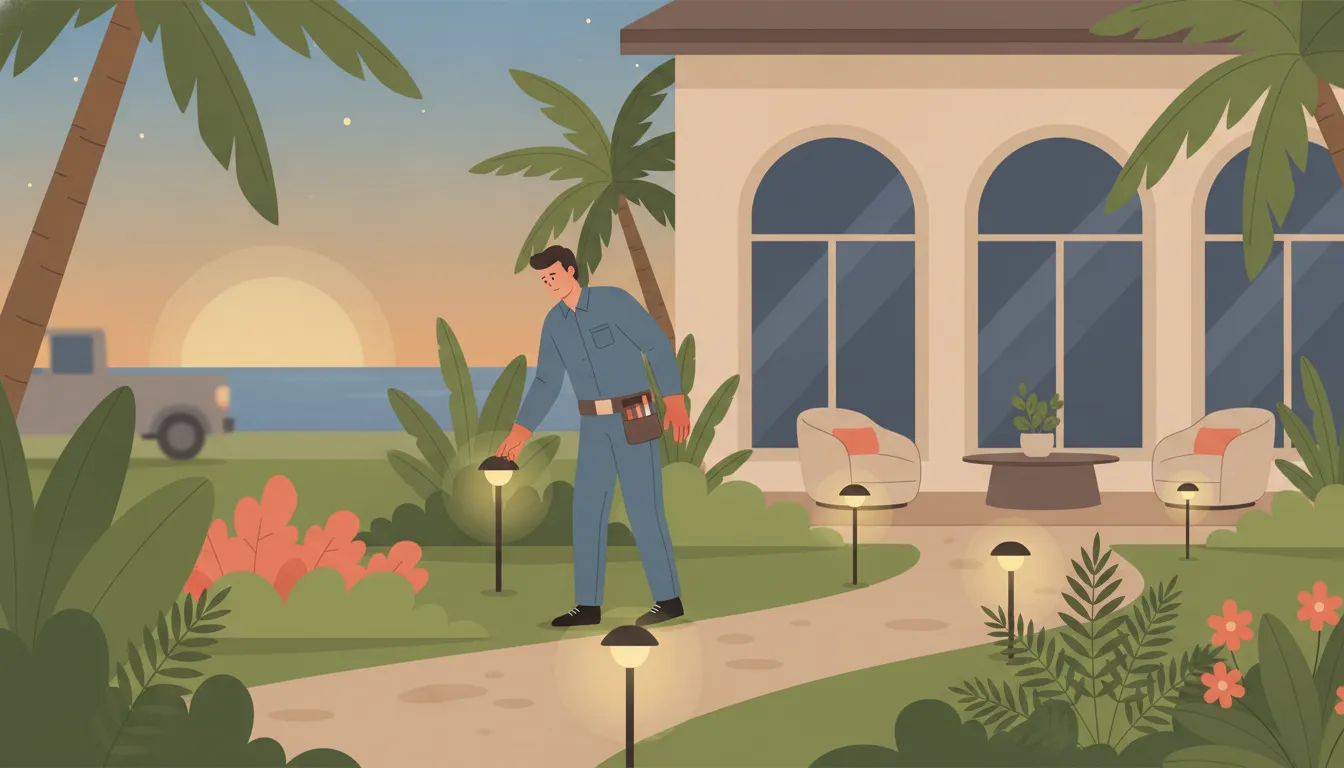
When patio or path lights start flickering, go dark, or show white buildup around the fixture, the problem is more than a burnt-out bulb. Moisture, corroded wiring, damaged connections, and transformer trouble can all interrupt outdoor lighting, especially in Jensen Beach's salt-air environment.
Outdoor lighting repair in Jensen Beach can restore flickering or dead landscape lights through safety-first diagnostics, targeted component repairs, and weather-conscious recommendations from a licensed local electrician. A professional can determine whether the fixture, wiring, or transformer is responsible before the issue spreads.
Prompt repairs also help preserve the lighting that guides walkways, highlights outdoor spaces, and reduces dark areas around your property. Start by recognizing the warning signs, then decide when a landscape-lighting problem calls for professional attention.
Signs Your Outdoor Landscape Lights Need Repair
Outdoor lighting problems usually announce themselves before the whole system stops working. You may notice a path light flickering as you walk to the door. Patio fixtures that remain dark after sunset, or one section of the landscape suddenly going out. These symptoms are worth addressing promptly, especially in Jensen Beach, where humidity and salt air can affect outdoor components.
Schedule outdoor lighting repair in Jensen Beach
Flickering path or patio lights
Flickering is not always just a loose bulb. It can point to a failing bulb, a poor connection, or damage developing in the wiring. If several fixtures flicker together, the problem may involve a shared connection or another part of the low-voltage system. Repeated flickering should not be ignored because timely repair can help prevent more extensive wiring damage.
Fixtures that stay dark or burn out repeatedly
A single burned-out bulb may be a simple replacement. However, a fixture that stays dark after a new bulb is installed, or one that burns through bulbs again and again, needs a closer inspection. The cause may be a damaged socket, a connection problem, moisture, or a transformer issue. Replacing bulbs without finding the underlying fault can leave the same failure unresolved.
Water, corrosion, or cracked wiring
Look for condensation or visible moisture inside a fixture housing, cloudy lenses, rust, or green and white buildup around metal connections. Water entry is a frequent cause of shorts in humid coastal environments. Also watch for exposed wiring or cracked insulation. Damaged insulation can allow moisture into the system and increase the risk of shorts, so avoid handling questionable wiring yourself.
Visible corrosion is another important warning sign for Jensen Beach homeowners. Salt-laden air can accelerate corrosion on fixture housings, connectors, and wiring. A fixture may still turn on while its connections are deteriorating, which is why a professional inspection can be safer than waiting for a complete failure.
A humming or tripping transformer
A transformer that hums loudly, feels unusually hot, or trips its breaker can indicate a problem that needs professional attention. The transformer supplies power to the low-voltage lighting system, so a fault there can affect multiple fixtures at once. A technician can diagnose the symptom safely and determine whether the issue is at the transformer, along the wiring, or at individual fixtures.
My Electrician uses safety-first diagnostics to identify the cause before recommending a repair. Professional outdoor lighting installation and repair can restore reliable illumination while helping protect walkways, patios, and darker areas of the property.
Why Coastal Air in Jensen Beach Wears Out Outdoor Lights
Outdoor lights in Jensen Beach face more than sun, rain, and everyday use. Salt carried inland by coastal air can settle on fixture housings, fasteners, wiring connections, and other exposed components. High humidity keeps that residue active for longer, creating conditions that accelerate corrosion. A path light that flickers, a patio fixture that goes dark. Or a landscape-lighting transformer that stops working may be showing the effects of the environment rather than a simple bulb problem.
Corrosion can affect the outside of a fixture first, but the risk does not stop there. Salt exposure can weaken housing materials and connections, while moisture can enter cracked seals or damaged fixtures. Wiring corrosion increases resistance and can contribute to intermittent operation. In humid conditions, cracked insulation or exposed wiring also deserves prompt attention because it can increase the risk of shorts. These are reasons that Jensen Beach electrical services should include a coastal-aware inspection, not just a quick bulb replacement.
Salt air affects more than the fixture housing
Outdoor lighting systems depend on several connected parts working together. Corrosion at a terminal can interrupt power to multiple fixtures. A deteriorated connector can produce flickering or leave part of a lighting run dark. Moisture inside a fixture may damage the socket or create a short. Transformers and low-voltage connections are also exposed to the same air and humidity, so a system can appear to fail in several places at once.
Regular inspection helps identify these problems while the repair is still contained. A technician can look for salt buildup, discoloration, rust, water entry, loose connections, and damaged insulation. Replacing a corroded connection or compromised fixture may restore reliable operation without requiring a complete redesign. The appropriate repair depends on the condition of the components and the safety of the existing installation.
Why coastal corrosion matters over time
The broader infrastructure risk is well documented. The National Institute of Standards and Technology reports that increased temperature and humidity can promote steel corrosion and accelerate deterioration in coastal areas. Its projections indicate that the useful life of steel structures could decrease by 7.9% to 15.9% by the end of the century under the RCP 8.5 scenario. Outdoor lighting components are smaller than those structures, but the principle is relevant: a coastal environment can shorten the useful life of exposed materials. NIST's coastal corrosion research provides the authoritative context.
For Jensen Beach homeowners, resilience starts with suitable materials, sound connections, and timely repairs. A licensed electrician can diagnose the homeowner-visible symptom, address the underlying electrical issue, and verify that the system is safe to keep operating. Local experience matters because outdoor lighting installed along the Treasure Coast must stand up to both humidity and salt exposure.
How Professional Outdoor Lighting Repair in Jensen Beach Works
When path lights go dark, fixtures flicker, or several landscape lights stop working at once. A professional repair should identify the underlying problem rather than simply replace the most visible bulb. Outdoor systems combine fixtures, low-voltage wiring, connectors, timers, photocells, and a transformer. In Jensen Beach, moisture and salt air can also accelerate corrosion around housings and connections. A careful repair process protects the system and helps prevent the same failure from returning.
Start with a safety-first diagnostic inspection
The technician begins by listening to what you observed, such as flickering lights, dead fixtures, or a section of the yard that no longer illuminates. The inspection then covers the transformer, timer or photocell, fixtures, connections, and visible wiring. Technicians look for water inside fixtures, burned or loose connections, exposed conductors, cracked insulation, and corrosion. Even low-voltage systems are not a reason to guess or work around an electrical fault. Professional diagnostics help identify the root symptom while keeping the repair aligned with electrical safety requirements.
Check transformer output and voltage at each fixture
A landscape lighting system can appear to have a fixture problem when the transformer is not delivering the correct output or when voltage is dropping somewhere along the run. The technician tests the transformer first, then checks the voltage reaching individual fixtures and sections of the system. This step helps distinguish a transformer malfunction from a damaged connection, overloaded run, or low-voltage wiring issue. Testing across the system is more reliable than replacing fixtures one at a time and hoping the lights come back on.
Test and replace bulbs or fixtures as needed
Once the power path is understood, the technician tests bulbs and fixtures for failure, moisture intrusion, burned components, and physical damage. A failed bulb may be a straightforward replacement, but repeated burnouts or a dark fixture can point to a deeper issue. If a fixture has corroded contacts or water damage, replacing only the bulb may leave the problem unresolved. The repair recommendation should match the condition of the component and the way the system is intended to operate.
Repair corroded or damaged low-voltage wiring
Salt-laden air and humid coastal conditions can affect wiring connections, insulation, and fixture terminals over time. The technician repairs or replaces damaged sections, restores sound connections, and addresses exposed wiring or cracked insulation that could lead to shorts. Low-voltage wiring needs specialized attention because a small fault can affect multiple fixtures. Where replacement is needed, the goal is a durable repair suited to the outdoor environment, not a temporary connection that fails after the next period of moisture.
Test and verify the complete lighting system
After the repair, the technician operates the full system and verifies that fixtures illuminate consistently, controls respond correctly, and voltage remains appropriate throughout the run. This final check can reveal a second weak connection or a fixture that was masked by the original failure. My Electrician uses direct employee technicians rather than subcontractors, and the company provides a 2-year parts-and-labor warranty on work performed by its technicians. You can also expect upfront flat-rate pricing before authorized work begins. For help with your system, see residential lighting repair.
Are LED Outdoor Lighting Upgrades Worth It?
For many Jensen Beach homeowners, replacing an aging halogen landscape system with low-voltage LED fixtures is worthwhile. Especially when repeated bulb failures, excess heat, or rising operating costs are already making the system frustrating to use. LEDs can reduce energy consumption by up to 80% compared with older halogen systems. Although the actual savings depend on the number of fixtures, operating schedule, and selected equipment.
An upgrade is not automatically the right answer for every property. A technician should first determine whether the problem is a failed bulb, damaged wiring, a malfunctioning transformer, or a fixture that has allowed moisture inside. If the existing wiring and housings are in good condition, compatible LED lamps may be practical. If coastal corrosion has affected connections or fixtures, replacement can be more reliable than repeatedly repairing the same weak points.
| Consideration | Older halogen system | Modern low-voltage LED system |
|---|---|---|
| Energy use | Typically uses more electricity for comparable outdoor illumination. | Can use up to 80% less energy than halogen, according to the customer's lighting research. |
| Heat output | Produces substantial heat around bulbs and fixtures, which can accelerate wear in some installations. | Generally produces less heat during operation, helping fixtures stay more comfortable to handle during service. |
| Bulb life | Requires more frequent bulb replacement as lamps burn out. | Usually reduces routine bulb changes, though the complete fixture, driver, connections, and controls still need inspection. |
| Fixture compatibility | Existing housings may accept halogen lamps but may not be ideal for every LED conversion. | Some LED lamps fit existing fixtures, while other systems need compatible LED fixtures, transformers, or connectors. |
| Repair and maintenance | More frequent bulb service can add inconvenience, particularly when fixtures also have moisture or corrosion damage. | Less lamp maintenance can help, but coastal connections, wiring, transformers, timers, and motion sensors still require professional checks. |
| Up-front cost versus long-term savings | Lower initial replacement cost may be offset by higher energy use and recurring lamp changes. | Equipment and installation may cost more initially, with potential savings from lower energy use and reduced routine replacement. |
What should you look for in an LED system?
Efficiency is more useful than wattage alone. The U.S. Department of Energy defines Luminaire Efficacy Rating, or LER, as light output divided by electrical power input, measured in lumens per watt. A higher LER indicates more light for the same power. For pole- or arm-mounted area and roadway luminaires, the federal purchasing guidance lists a minimum LER of 136 lm/W. The guidance also identifies IES LM-79-08 as an industry-recognized performance test method for solid-state lighting products. These measures can help compare equipment, but fixture placement, beam spread, color, and glare matter just as much for a residential property.
Timers and motion sensors can add further energy savings and improve security by limiting operation to useful hours. Before changing a system, ask an electrician to confirm compatibility and inspect the low-voltage wiring. My Electrician can evaluate upgrade and repair options through our electrical services, including when DOE efficiency guidance is relevant to the equipment being considered.
How Often Should You Service Outdoor Lighting?
For most homes, schedule outdoor lighting maintenance at least once a year. An annual visit can catch dirty fixtures, burned-out bulbs, loose connections, and early wiring problems before a small issue leaves an entire walkway or patio dark. In Jensen Beach, however, a calendar-based plan should account for coastal conditions. Salt-laden air can accelerate corrosion on outdoor electrical components, so fixtures and connections deserve closer attention than they might in an inland location.
A practical Florida cadence is an annual baseline inspection, followed by a pre-hurricane-season check and a post-storm review when strong wind, heavy rain, or flooding affects your property. The pre-season visit is a good time to confirm that fixtures are secure, connections are protected. Timers and photocells respond correctly, and exposed wiring or cracked insulation is not creating a safety risk. After a storm, look for shifted fixtures, water inside housings, damaged cable, and lights that flicker or fail to turn on. Do not handle a damaged fixture or exposed wire while the system is energized. Have a qualified professional assess it instead.
Homes near the water, properties with older systems, and landscapes that use many fixtures may benefit from more frequent checks. Frequent irrigation, standing water, dense vegetation, and visible salt buildup can all shorten the time between service visits. Regular maintenance also helps identify wiring concerns before they become a complete system failure, as documented in the maintenance guidance for outdoor lighting systems.
What does a professional maintenance visit include?
A thorough visit goes beyond replacing a bulb. The technician should inspect each fixture for moisture entry, corrosion, cracked housings, loose mounting, and physical damage. Cleaning lenses and housings helps restore the intended light output. The technician can also check bulbs or LED modules. Confirm that timers and photocells operate at the right times, and examine cable routes for exposed wiring or cracked insulation.
For a low-voltage landscape system, diagnostics should include checking transformer output and confirming that the proper voltage reaches the fixtures throughout the circuit. Connections may need attention where humidity and salt exposure have caused corrosion. A safety-first inspection should explain what is routine maintenance, what needs repair, and whether replacement is more practical for a severely damaged component. Professional residential lighting repair can address those problems without guessing at the cause.
How can you tell maintenance from a needed repair?
Routine maintenance is generally planned work, such as cleaning fixtures, checking bulbs, testing controls, and inspecting connections while the system still operates normally. A repair is warranted when lights flicker, remain dark after a known-good bulb is installed. Trip a breaker, show water inside the housing, or display visible corrosion, burning, damaged insulation, or loose wiring. Flickering can be an early sign of a connection issue or failing bulb, but it should not be ignored because the underlying problem may worsen.
If outdoor lighting stopped working after a storm or the symptom keeps returning after basic maintenance, schedule an inspection rather than repeatedly resetting the system. Timely service can protect the lighting system, reduce dark areas around the property, and help keep outdoor electrical work safe.
Schedule Service for dependable outdoor lighting repair in Jensen Beach.
Frequently Asked Questions
What are the common causes of outdoor lighting failure?
Outdoor lights commonly fail because moisture enters a fixture, a bulb burns out, wiring corrodes, or the transformer stops working. Flickering may point to a failing bulb or a connection problem. A technician can inspect the fixture, wiring, transformer, timer, and photocell instead of replacing parts at random.
How often should outdoor lighting systems be serviced?
Plan on professional service at least once a year, including fixture cleaning and bulb checks. In Jensen Beach, more frequent visual checks may be worthwhile because salt air and humidity can accelerate corrosion. Call sooner if lights flicker, stay dark, show water inside the housing, or have exposed wiring.
Are LED outdoor lighting systems energy-efficient?
Yes. Modern low-voltage LED systems can use up to 80% less energy than older halogen systems. Timers and motion sensors can provide additional energy savings while keeping walkways and entry points illuminated when needed. See the U.S. Department of Energy guidance on efficient exterior lighting for more information.
Can professional outdoor lighting repair improve home security?
It can. Restoring failed path, entry, driveway, and patio lights helps remove dark areas around the property, improving visibility for residents and visitors. A professional inspection also checks whether timers and photocells operate correctly, so the system turns on when it should.
Why is outdoor lighting maintenance important in coastal areas like Jensen Beach?
Salt-laden coastal air accelerates corrosion on outdoor fixtures, wiring connections, and other electrical components. Regular inspections help identify corrosion, cracked insulation, and moisture intrusion before they cause a larger failure. Choosing corrosion-resistant components and addressing damage early can help the system last longer.
Schedule Outdoor Lighting Repair in Jensen Beach
Flickering, dark, or damaged landscape lights can make it harder to enjoy your outdoor spaces and may point to an issue that deserves professional attention. A safety-first evaluation can help identify the right repair for your home's lighting system. Schedule Service by calling 877-762-7483 and talk with the My Electrician FL team about your outdoor lighting repair needs.