
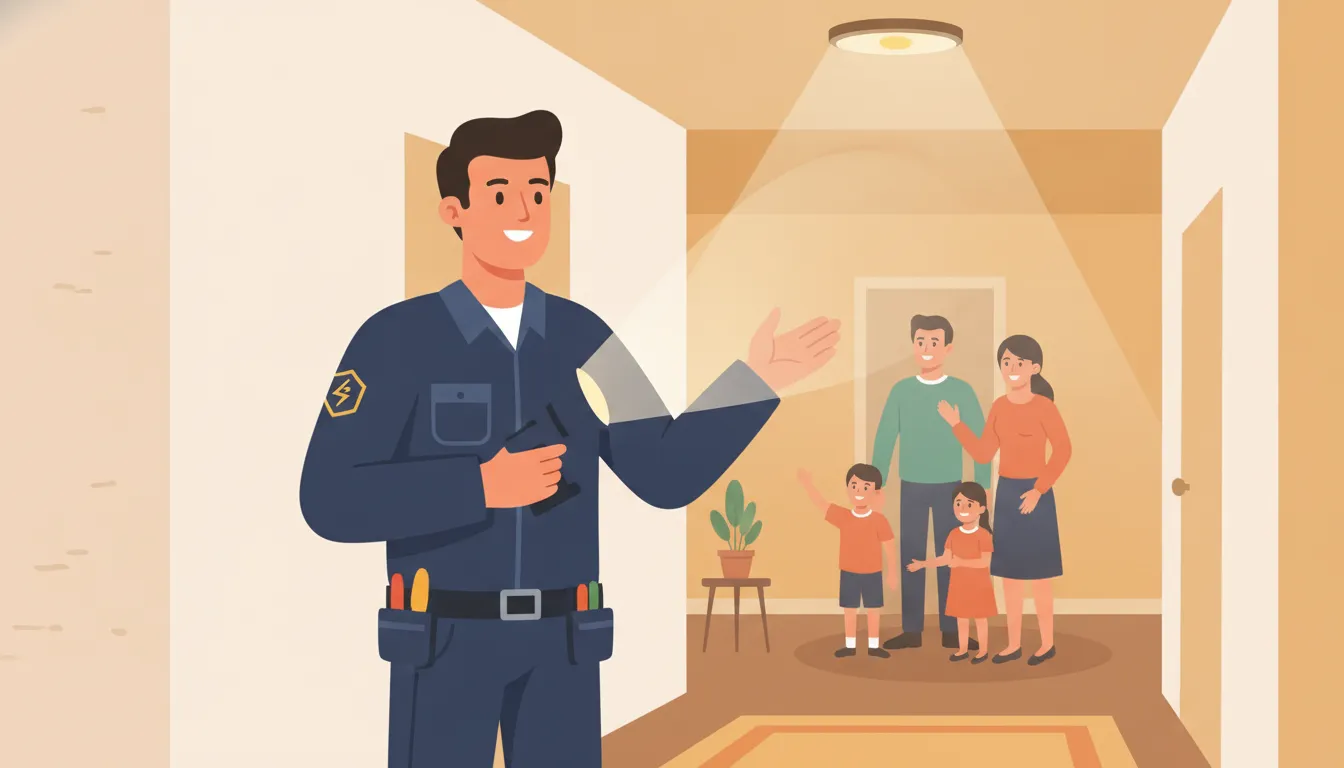
When a light suddenly goes out, starts flickering, or leaves part of your home in darkness, the problem is more than an inconvenience. It can affect safe movement through hallways and stairs, especially at night, and may signal a wider electrical issue.
Emergency lighting repair is appropriate when sudden light loss occurs with flickering, sparking, a burning smell, buzzing, or a breaker that will not stay on. Turn off the affected switch or circuit if it is safe to do so. Keep away from damaged wiring, and call an emergency electrician rather than taking apart the fixture.
My Electrician provides 24/7/365 emergency electrical service for urgent residential problems, including sudden circuit failures and sparking outlets. The safest next step depends on what you can observe, where the failure occurred, and whether other rooms or outlets are affected. Knowing which symptoms require immediate attention can help you protect your household while a professional evaluates the issue.
Schedule emergency electrical service today and get prompt help when lights fail.
What Counts as an Emergency Lighting Problem in Your Home?
Some lighting problems are inconvenient, but others signal an active electrical hazard. If lights suddenly go out in one room, begin flickering throughout the house. Buzz when switched on, or leave you resetting the same breaker repeatedly, pay attention to what happens next. A burning smell, warmth around a switch or outlet, visible sparks, smoke, or a crackling sound calls for immediate caution.
Do not keep using a fixture, switch, or outlet that smells scorched, feels hot, or shows signs of damage. Turn it off if you can do so safely, keep children away from the area, and avoid touching exposed wiring. If the problem affects multiple rooms or returns after you reset a breaker, the issue may extend beyond a single bulb or fixture.
Flickering lights, sparking outlets, and sudden circuit failures are electrical problems that warrant a 24/7 emergency electrician. My Electrician, Inc. identifies emergency electrical service as available around the clock for urgent residential issues. That prompt response matters when lighting problems leave stairways, hallways, entrances, or other paths difficult to navigate.
Which lighting symptoms should concern homeowners?
- Lights suddenly go out: A single failed bulb may be routine, but a sudden outage affecting a circuit, room, or several fixtures deserves closer attention.
- Lights flicker or dim: Repeated flickering, especially when appliances start, can point to an electrical problem that should be evaluated rather than ignored.
- A fixture buzzes, crackles, or pops: Unusual sounds from a light, switch, or dimmer are not normal operating noises.
- A breaker keeps tripping: Repeated trips are a warning, not an invitation to keep resetting the panel. Leave the breaker off if the problem returns.
- You notice burning, smoke, or heat: Shut off power to the affected area only if the panel and surrounding conditions are safe to approach, then call for help.
Emergency lighting problems can also involve battery-backed fixtures or lights intended to help people move safely during a power interruption. A failed light in a dark stairwell or hallway can increase the risk of a fall. Especially for children, older adults, and anyone moving through the home at night. Treat the loss of that safety lighting as urgent when you cannot restore it safely with a simple bulb replacement.
When in doubt, do not open a fixture or attempt wiring repairs. A qualified professional can determine whether the visible symptom comes from the light itself, the switch, the circuit, or a broader power issue.
Why Do Emergency and Exit Lights Fail?
When an emergency or exit light does not come on, the problem may be simple, but it should not be ignored. A dark fixture, a light that flickers during a test, or an indicator that never changes can mean the system is not ready when your home needs it. Emergency lighting helps illuminate paths out of a building during a power interruption, so a failure deserves prompt attention.
Battery problems are a common cause
Battery degradation is often the silent culprit behind emergency light breakdowns. Rechargeable batteries lose their ability to hold a charge over time, even when the fixture appears normal during everyday use. The light may work briefly and then go dark, or it may fail as soon as the power goes out. A battery can also be weakened by heat, long periods without maintenance, or repeated charging cycles.
Replacing a battery may restore the fixture, but the battery is not always the only problem. The charger, wiring, connections, and test switch also need to work together. If a replacement battery does not solve the issue, continued testing can waste time and leave the system unreliable.
Circuit issues can stop the fixture from charging
Emergency and exit lights depend on a working electrical supply to keep their batteries charged. A tripped breaker, loose connection, damaged wiring, or another circuit problem can interrupt that supply. Homeowners may notice other symptoms first, such as lights flickering, a breaker that keeps tripping, buzzing, or several fixtures going out at once. Sparking or a burning smell is a more urgent warning. Turn off power if it is safe to do so and contact an electrician rather than opening the fixture.
Professional electricians can use circuit analyzers and thermal imaging to find overheating connections or electrical faults that are not visible from the outside. This helps identify whether the fixture needs repair, the circuit needs attention, or both. More information about electrical troubleshooting is available through electrical repair services.
Aged fixtures may no longer perform reliably
Older emergency and exit-light fixtures can develop worn switches, cloudy lenses, corroded terminals, failing chargers, or damaged internal parts. An aging fixture may pass one test and fail the next, which is why an occasional quick check is not enough to establish dependable operation.
NFPA 101 Life Safety Code requires 30-second emergency-lighting tests every 30 days to confirm system functionality, according to emergency-lighting inspection guidance from Hiller Fire. If a fixture fails a test, does not stay illuminated, or shows signs of electrical damage, arrange professional emergency lighting repair instead of assuming a new bulb will fix it.
Immediate Safety Steps When Lights Suddenly Fail
When lights go out without warning, focus first on keeping people safe rather than immediately testing switches or opening electrical equipment. A dark hallway, stairway, or exit path can create a fall hazard. While a burning smell, buzzing, sparking, or a failed circuit may signal a more serious electrical problem. Use this sequence to stabilize the situation while you decide whether professional emergency lighting repair is needed.
- Move people away from hazards. Use a flashlight or phone light to guide children, older adults. And anyone with limited mobility away from dark stairs, wet areas, exposed wiring, or equipment that is sparking. Do not use a candle near curtains, bedding, paper, or other combustible materials.
- Look and listen for warning signs. From a safe distance, check for smoke, a burning odor, buzzing, crackling, visible sparks, or heat around an outlet, switch, panel, or light fixture. Do not touch a hot, damaged, wet, or sparking device. If there is smoke or fire, leave immediately and call 911.
- Check whether the outage is limited or widespread. If it is safe to do so, see whether neighboring rooms or nearby homes also lost power. You may check the electrical panel visually, but do not repeatedly reset a breaker that trips again, and never remove the panel cover. A repeated trip can indicate a dangerous underlying fault.
- Use backup power safely. If you use a gasoline-powered generator, the CDC says never to operate it inside a home, basement, or garage, or within 20 feet of a window, door, or vent. Carbon monoxide is odorless and colorless, yet it can cause sudden illness or death. Keep the generator outdoors in a dry, well-ventilated location, and follow the manufacturer's instructions.
- Protect essential pathways. Keep exits, hallways, and stairways clear while the lighting is out. Do not assume an emergency light or exit light is dependable simply because its indicator appears illuminated. If an emergency fixture fails its test, stays dark, or does not remain on during an outage, treat it as a life-safety concern and avoid relying on it.
- Call for help when symptoms point to an electrical emergency. Flickering lights, sparking outlets, sudden circuit failures, or a burning smell deserve prompt attention. My Electrician provides 24/7 emergency electrical service. Leave the affected area if conditions worsen, and wait for an electrician rather than attempting wiring repairs yourself.
After everyone is safe, note which fixtures failed and what happened immediately beforehand. That information can help an electrician locate the problem faster without putting you at risk.
Can You Handle Emergency Lighting Repair Yourself?
Sometimes, a simple check can restore an emergency light. If the fixture is designed for homeowner maintenance, you may be able to replace a burned-out bulb, reset a tripped breaker, or install a manufacturer-approved battery backup. These steps are reasonable only when the fixture is cool, dry, and free of visible damage. And you can complete them without removing energized wiring or opening parts that you do not understand.
| When a simple DIY check makes sense | When you should call an electrician |
|---|---|
| Fixture is cool, dry, and free of visible damage | Buzzing, heat, scorch marks, or a burning odor |
| Replacing a bulb, a battery, or resetting a tripped breaker | Sparks, smoke, water near the fixture, or exposed conductors |
| You can complete the step without removing energized wiring | A breaker trips again or the cause is not visible from outside |
| Test confirms the light works after the change | The failure sits on a circuit that supplies several fixtures |
What you can safely check
- Turn off the light's circuit at the breaker before replacing a bulb or battery, and follow the fixture manufacturer's instructions.
- Check whether a breaker has tripped if the emergency light and other nearby fixtures suddenly stop working. Reset it only once if there is no burning smell, smoke, sparking, or visible damage.
- Replace a battery only with the correct type and rating. A replacement battery will not solve a problem caused by damaged wiring, a failed charger, or a defective circuit board.
- Test the light after maintenance according to the fixture instructions. A light that works on normal power may still fail when the power goes out.
Stop immediately if you notice buzzing, heat, scorch marks, a burning odor, flickering, exposed conductors, water near the fixture, or a breaker that trips again. Do not bypass a breaker, splice wires, or keep resetting the circuit to make the light work. Those symptoms can point to a wiring or circuit problem rather than a replaceable bulb or battery.
Why a professional may be needed
Many emergency lighting failures involve battery systems or wiring behind the fixture. The battery may have degraded, but the charging circuit may also be faulty. A loose connection, damaged conductor, or problem on the supplying circuit can create a hazard that is not visible from the outside. Emergency and exit lighting also supports safe movement during a power failure. So a fixture that appears to operate normally should not be treated as reliable if it fails a test.
If the cause is unclear, use a qualified electrician for electrical repair rather than guessing. A professional can isolate the circuit and use tools such as thermal imaging or circuit analyzers to identify abnormal heat, wiring faults, or charging problems. Call for urgent help when the failure occurs with sparking, smoke, a burning smell, or a sudden circuit failure. Avoid working on the fixture until it has been assessed.
When to Call for Professional Emergency Lighting Repair
A single emergency light that does not turn on during a test may need attention, but some warning signs call for prompt professional help. Do not wait to see whether the problem clears up when you notice a burning smell, buzzing near a fixture, visible sparks, or lights that flicker repeatedly. These symptoms can point to an electrical problem that is more serious than a worn-out lamp or battery.
Call for help right away if emergency or regular lights fail across multiple rooms, especially when the outage is sudden or accompanied by a tripped breaker. Flickering lights, sparking outlets, sudden circuit failures, and other abrupt power problems are reasons to contact an emergency electrician. You can review emergency electrical service options while you arrange assistance, but do not handle a dangerous symptom by repeatedly resetting the breaker or touching a warm, damaged, or sparking fixture.
Warning signs that should not wait
- Burning or overheated smells: Turn off power to the affected area if you can do so safely, and keep away from the fixture until it has been evaluated.
- Buzzing, crackling, or sparking: Unusual sounds or visible sparks near a light, outlet, switch, or panel require immediate attention.
- Flickering or repeated failures: Ongoing flickering is not something to ignore, particularly if several fixtures are affected.
- Multi-room outages: A sudden loss of lighting in more than one room may involve a circuit or broader electrical issue.
- A failed emergency light when visibility matters: If the light serves a stairway, hallway, exit path, or another area needed for safe movement, arrange repair promptly.
Emergency lighting supports safe movement when normal lighting is unavailable. A failed unit may have a degraded battery, but sudden failure can also be connected to an electrical circuit issue. Finding the cause matters more than simply replacing a bulb, because a new bulb will not correct damaged wiring, a failing connection, or a circuit problem.
My Electrician provides 24/7/365 emergency electrical service for urgent residential issues, so homeowners do not have to wait for regular business hours when warning signs appear. If the situation includes smoke, active sparking, or immediate danger, move away from the area and call emergency services when appropriate. Otherwise, contact a qualified electrical professional for electrical repair as soon as possible, and describe exactly what you saw, heard, or smelled. Clear symptom details help the technician prepare for a safer, more focused diagnosis.
How Professional Emergency Lighting Repair Works
When an emergency light stops working, a professional electrician starts by listening to what you observed. A unit that stays dark, flickers, buzzes, trips a breaker. Or fails during a power interruption can have a worn battery, a damaged connection, or a problem elsewhere in the circuit. The visible fixture is not always the source of the failure, so replacing a bulb or battery without testing the system can leave the safety problem unresolved.
The first step is a careful inspection. The electrician checks the fixture, wiring, power supply, battery condition, switches, and related circuit components. Specialized tools, including infrared cameras, thermal imaging, and circuit analyzers, can help identify heat, electrical abnormalities, and connection problems that are not obvious during a visual inspection. These tools support a more precise diagnosis and help avoid unnecessary replacement of parts. Learn more about the diagnostic approach.
From diagnosis to a practical repair
Once the cause is clear, the electrician explains what failed and what needs to be corrected. A repair may involve replacing a degraded battery, repairing a connection, correcting a circuit issue, or replacing a fixture that can no longer operate safely. The work should also include testing the light after the repair, including its response when normal power is interrupted. That final check confirms the system is doing more than simply turning on at the wall.
Clear communication matters during an urgent repair. My Electrician uses upfront flat-rate pricing rather than hourly rates, so homeowners can review the expected cost before work begins. The company also provides a 2-year written guarantee on parts and labor. Those details give you a clear record of the repair and what support is available afterward. Schedule electrical repair service if a failed emergency light is accompanied by sparking, burning odors, repeated breaker trips, or another sign of an active electrical problem.
Preventing Future Emergency Lighting Failures
Once an emergency light has been repaired, a few simple habits can help you catch the next problem before the fixture is needed. The goal is not to take apart electrical equipment or guess at a hidden wiring issue. It is to notice visible changes, keep fixtures accessible, and arrange professional help when a warning sign does not go away.
Test battery backup fixtures regularly
Test each battery-powered emergency fixture according to the manufacturer's instructions. A brief test can show whether the light turns on when normal power is interrupted and whether the battery appears able to support it. If the fixture does not illuminate, looks unusually dim, or shuts off quickly, schedule emergency lighting repair rather than assuming the battery will recover on its own.
Regular testing is also consistent with the broader life-safety purpose of emergency lighting. NFPA 101 guidance cited by fire-safety professionals calls for 30-second emergency lighting tests every 30 days to confirm system function. Homeowners can mirror that practical habit, while businesses and other regulated properties should follow the requirements that apply to their building and have testing documented when required.
Replace aged bulbs and watch for flickering
A bulb that is dim, discolored, or nearing the end of its service life deserves attention before it fails during an outage. Use the correct replacement specified for the fixture. If a new bulb flickers, buzzes, or fails to solve the problem, stop replacing parts at random. The issue may involve the battery, socket, charging circuit, switch, or another electrical connection.
Flickering is especially useful as an early warning. It may come and go, but that does not make it harmless. Note when it occurs and whether other lights or appliances are affected. A timely inspection can identify a developing circuit problem before it becomes a sudden lighting failure.
Keep exit paths and fixtures clear
Emergency lighting cannot guide anyone effectively if furniture, storage boxes, curtains, or decorations block the fixture or the path it is meant to illuminate. Keep the area beneath exit-path lighting open and make sure the fixture remains visible from the route. During seasonal decorating or home projects, check that nothing has been placed in front of the light.
These small checks provide reassurance, but they do not replace a professional evaluation when a fixture repeatedly fails, shows heat damage, or has loose or exposed wiring. An electrician can test the battery and charging system, inspect the circuit, and correct the cause instead of treating only the symptom.
Schedule electrical repair with a licensed electrician to protect your home's lighting.
Frequently Asked Questions
Can you replace bulbs in emergency lights?
Sometimes, but a dark fixture is not always a burned-out bulb. The battery, charger, wiring, switch, or circuit may be the actual source of the failure. Turn off power before inspecting any accessible fixture, and do not open a unit that is sparking, hot, buzzing, or connected to damaged wiring. A qualified electrician can determine whether the bulb, battery, fixture, or circuit needs attention.
How do emergency lights work when the power goes out?
Emergency lights typically use a rechargeable battery that powers the fixture when normal electrical power is interrupted. If the light does not activate during an outage, the battery may be depleted or degraded, or the unit may not be receiving power while it is charging. A sudden failure in several fixtures may point to a circuit or broader electrical problem rather than one bad bulb.
How can I troubleshoot an emergency light safely?
First, notice whether other lights or outlets are also affected. If a breaker has tripped, you can check it once without touching exposed wiring. Stop and call an electrician if you smell burning, see sparks, hear buzzing, or the breaker trips again. If you use backup power, never operate a gasoline-powered generator inside a home, basement, or garage, because carbon monoxide is odorless and can cause sudden illness or death. CDC power outage safety guidance
When should I call for emergency lighting repair?
Call for prompt electrical help when the failure involves flickering, sparking, a burning smell, repeated breaker trips, or a sudden circuit failure. Emergency lighting supports safe movement and exit during a power loss, so a nonworking fixture should not be ignored when people depend on it. My Electrician, Inc. provides 24/7/365 emergency electrical service for urgent residential issues. Learn about emergency electrical service
Schedule Emergency Lighting Repair
When a sudden light failure leaves part of your home unsafe or difficult to navigate, professional troubleshooting can help identify the problem and restore dependable lighting. Schedule emergency lighting repair with My Electrician FL's 24/7 emergency team for clear next steps and safety-focused service.