
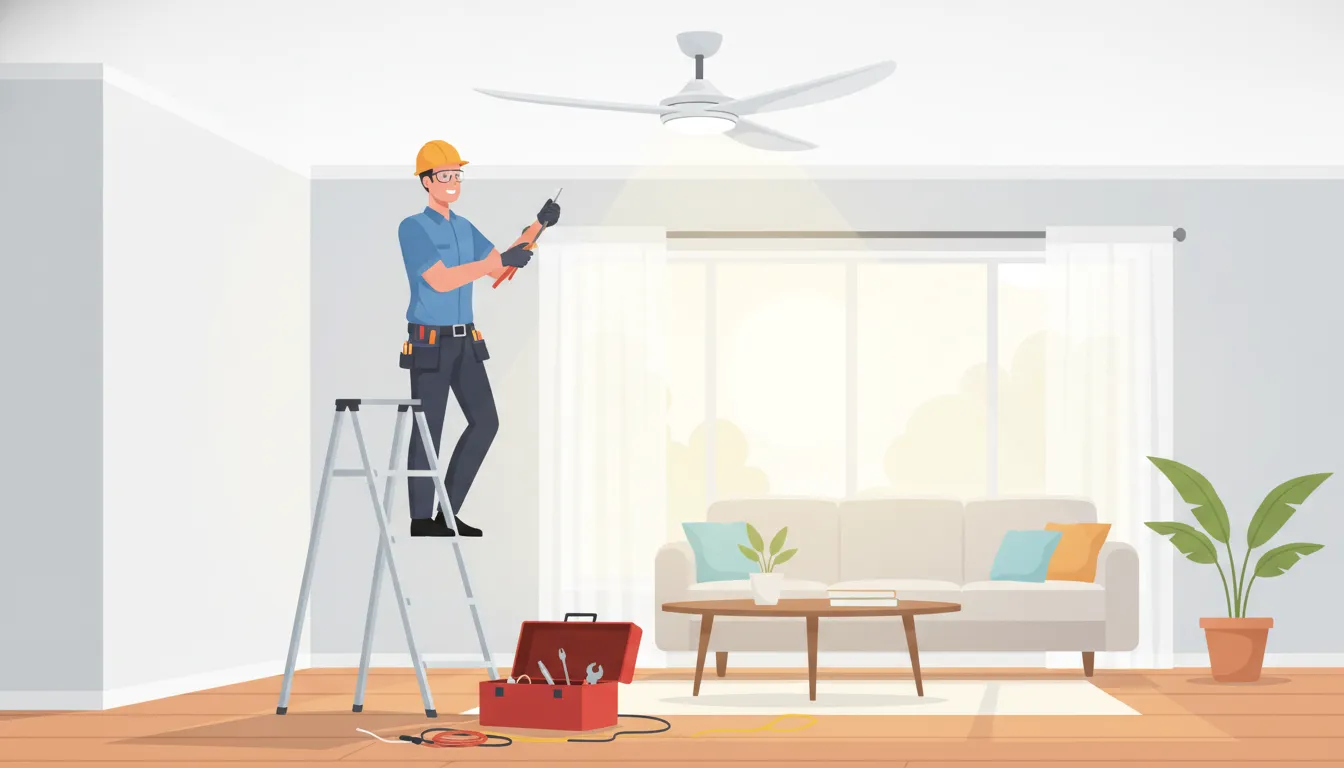
A ceiling fan can seem like a straightforward fixture swap, especially when a light already occupies the spot. The part homeowners cannot see is often the part that determines whether the finished fan is secure, quiet, and safe. A professional electrician checks the existing electrical box, confirms that it can support a fan. Evaluates the ceiling framing, and makes sure the wiring and controls are connected correctly.
Ceiling fan installation may be manageable for an experienced homeowner when a properly rated fan box and suitable wiring are already in place. Hire a licensed electrician when the box needs replacement, the fan is heavy. The ceiling framing is unusual, wiring is unclear, or you are not comfortable working around electrical connections.
That distinction matters in older South Florida homes, where a light-fixture box may not be designed for the movement and weight of a ceiling fan. My Electrician FL provides upfront, flat-rate pricing and sends employed, licensed technicians who can explain the work before it begins.
Schedule Service for professional ceiling fan installation
The right decision starts with the condition of the existing fixture location, not just the instructions in the fan's box. Understanding what the electrical work involves can help you judge whether your project is a reasonable DIY task or one that deserves professional attention.
Is Ceiling Fan Installation a DIY Job or a Job for a Pro?
Installing a ceiling fan can be a reasonable DIY project when you are replacing an existing fan with a similar model. It works best when the power is safely shut off and the ceiling already has a fan-rated electrical box. In that limited situation, a confident homeowner may be able to follow the manufacturer's instructions and complete a straightforward switch-out.
The important question is not only whether the fan turns on. It must also be securely supported, correctly wired, and safe under the vibration and weight of a moving fixture. The U.S. Department of Energy's ENERGY STAR guidance notes that replacing a ceiling fixture with a fan will most likely require replacing the electrical box. An ordinary light-fixture box is not automatically strong enough for a fan.
When a homeowner may handle the switch-out
A basic replacement may be manageable if the existing box is clearly marked for ceiling fan use. It also helps when the fan is a comparable size and weight, the wiring is in good condition, and no new cable or structural support is needed. Follow the fan instructions, turn off the circuit at the breaker, and verify that the power is off before touching any conductors. If you cannot confidently identify the correct breaker or understand the wiring, stop and call a licensed electrician.
When ceiling fan installation needs a licensed electrician
Professional help is the safer choice when there is no existing electrical box. It is also the right move when the box is not fan-rated or the fan will be heavier than the current fixture. Dropper rods, large or specialty fans, vaulted ceilings, and locations away from a ceiling joist can require additional support or a specialized mounting bracket. A pro is also appropriate when new wiring must be run, the switch arrangement is changing. The ceiling needs to be opened, or the existing wiring is old, damaged, or confusing.
Do not treat a wobbling fan, buzzing connection, burning smell, repeated breaker trips, or a warm switch as a minor installation issue. These symptoms can point to a mounting or electrical problem that needs prompt attention. My Electrician FL uses licensed, safety-focused technicians rather than a general handyman approach, with upfront flat-rate pricing before work begins.
For complex installations or any wiring you are not comfortable evaluating, speak with a licensed electrician.
| Consideration | DIY switch-out | Professional installation |
|---|---|---|
| Electrical box | Existing box clearly marked for ceiling fan use | Verified or replaced with a correctly rated box |
| Wiring | Simple, visible, and clearly understood | Grounding and connections checked to code |
| Support and framing | Fan mounts directly to a joist | Proper bracket installed for unusual ceilings |
| Heavy or specialty fans | Lightweight, comparable model only | Handled for any size and weight |
| Warranty and peace of mind | None | Workmanship and parts protected |
What Pro Electricians Do During Ceiling Fan Installation
A professional ceiling fan installation is more than attaching blades to a motor and connecting a few wires. The electrician checks the ceiling, the electrical box, the circuit, and the manufacturer's instructions so the finished fan is secure, quiet, and ready for everyday use. A trained workflow also helps prevent common problems such as wobbling, flickering lights, unexpected breaker trips, or a fan that will not respond to its remote.
Shut off power and verify the circuit
The technician turns off the correct breaker before opening the ceiling box or handling any wiring. Power is then tested at the fixture with an appropriate meter, rather than relying only on a wall switch. This matters because a switch may control only part of the circuit, or another wiring issue may leave conductors energized. Confirming a de-energized circuit is the first safety check in any ceiling fan installation.
Inspect the existing electrical box
A standard light-fixture box is not automatically strong enough for a ceiling fan's weight and vibration. The electrician verifies that the box is specifically rated for fan use and securely attached. ENERGY STAR advises using a UL-listed box marked "For Use With Ceiling Fans," which serves as the attachment point for the fan. If the existing box is not fan-rated, the technician replaces it instead of relying on an unsafe shortcut.
Secure the mounting bracket to the structure
The mounting bracket must transfer the fan's movement and weight into solid structural support. The electrician locates a ceiling joist when possible and fastens the bracket with the correct hardware. If the fan location falls between joists, a specialized fan-support bracket may be needed. The bracket is leveled and tightened before the motor is hung, reducing the chance of movement, sagging, or persistent wobble.
Complete the wiring according to the design
The technician connects the grounding conductor and the supply wires according to applicable electrical requirements and the fan manufacturer's directions. Separate controls may be needed for the motor and light kit, while remote-controlled models may use a receiver in the canopy. Connections are secured inside the approved box, with no exposed conductors or strained wires. The electrician also checks that the circuit and controls are suitable for the installed equipment.
Install the blades and light kit
Once the motor assembly is supported, the blades are attached evenly and the optional light kit is installed. Each screw and connection is tightened to the manufacturer's specifications. The light kit, bulbs, and glass are checked for proper fit so the fixture does not rattle during operation. Installation details can vary by model, which is why experienced technicians follow the supplied instructions instead of assuming every fan assembles the same way.
Balance the fan and test every function
Before leaving, the electrician runs the fan at multiple speeds and checks for vibration, noise, and stable rotation. Blade alignment and tight connections are reviewed, and a balancing kit can help correct a persistent wobble when needed. The light, wall control, pull chain, remote, and reverse function are tested as applicable. The final inspection confirms a clean, code-compliant finish and gives the homeowner confidence that the fan is ready for regular use.
My Electrician FL uses employed technicians with more than 10 years of experience, rather than subcontractors, to maintain consistent workmanship. For help with a fan or other electrical project, explore our full range of electrical services.
The Electrical Box: The Heart of a Safe Ceiling Fan Installation
A ceiling fan does more than hang from the ceiling. It moves, vibrates, and can weigh as much as 50 pounds, so the electrical box above it must support both the fixture and its movement. During a professional installation, the fan is bolted to a UL-listed electrical box specifically marked "For Use With Ceiling Fans." This is not the same as a basic box designed for a lightweight light fixture.
Why a standard light box is not enough
Standard light boxes are generally intended to hold a stationary fixture. A ceiling fan creates repeated motion and vibration as the blades rotate. If the box is not rated for that use, the mounting hardware can loosen. The fan can wobble, or the box can pull away from the ceiling over time. The box is also the attachment point for the fan, which makes its rating and installation central to the safety of the entire project. ENERGY STAR recommends using an appropriate UL-listed box marked for ceiling fans.
That is why replacing a light fixture with a fan usually involves replacing the electrical box as well. The existing box may look solid from below, but its visible condition does not confirm that it can handle the fan's weight or vibration. An electrician can open the ceiling area, identify how the box is secured, and replace it when the existing hardware is not fan-rated.
How the box connects to the ceiling structure
The fan-rated box must be anchored to structural framing, such as a ceiling joist, rather than attached only to drywall. A joist provides the solid support needed for a moving fixture. If the joist is not located where the fan needs to go, a professional can install a specialized mounting bracket between the joists. For an off-center joist, that may include a spiked-end ceiling fan bracket designed to grip the framing and create a secure mounting point.
This structural step is especially important when a fan is being installed in a new location. When the old fixture was mounted between joists, or when the ceiling has been modified in the past. The final location should be centered for the room's layout without sacrificing the support the fan requires.
If you are unsure whether the existing box is fan-rated, avoid hanging the fan and hoping the hardware holds. Schedule professional ceiling fan installation so the box, framing, and mounting point can be evaluated before the fan is energized.
Wiring, Codes, and Safety Checks Professionals Handle
A ceiling fan can look like a simple fixture, but the wiring behind it must safely support a motor, lights, controls, and constant vibration. During a professional ceiling fan installation, the electrician first considers whether the existing circuit has enough capacity for the fan and any light kit. Adding a fixture to a circuit that is already heavily loaded can contribute to nuisance trips, heat buildup, or unreliable operation. The goal is a fan that runs smoothly without creating a new electrical problem elsewhere in the home.
Grounding is another essential check. The fan, metal electrical box, and wiring system need a reliable path for fault current. If an older box is not fan-rated, or if the grounding conductor is missing, damaged. Or improperly connected, simply attaching the fan and turning the breaker back on is not a safe solution. The electrician identifies the condition before completing the connection and explains any repair that is needed.
Why wire connections matter
Loose, mismatched, or poorly secured wire connections can cause intermittent power, flickering lights, buzzing, or heat at the connection point. These symptoms may appear only when the fan changes speed or the light is switched on, which makes them easy to dismiss. A professional secures the conductors in the junction box, uses compatible connectors, and checks that the fan's wiring matches the switch, remote receiver, reverse function, and light kit. Pull chains and wall controls also need to operate the intended function instead of leaving a component partially energized.
Older South Florida homes deserve particular care. A home may contain older cable, raceways, or previous modifications that do not match the wiring shown in a current fan's instructions. An amateur installation can connect a new control to the wrong conductor. Leave a splice crowded or unsecured, or assume that an old light-fixture box can handle fan movement. Flickering, overheating, a burning odor, or repeated breaker trips are warning signs to stop using the fan and have the wiring evaluated.
Code compliance is not about adding paperwork to a small project. It helps ensure that the circuit, grounding, connections, box, and controls work together safely and remain serviceable later. My Electrician technicians are company employees rather than subcontractors, and the company backs parts and labor with a 2-year warranty. If your project involves new wiring, an older electrical system, or a fan that does not operate as expected, review professional ceiling fan installation options or explore the company's full range of electrical services.
How Much Does Ceiling Fan Installation Cost?
The cost of ceiling fan installation depends less on the fan itself than on the electrical work already in your ceiling. Replacing a fan in an existing, properly supported location is usually a more straightforward job than installing one where a light fixture. An outdated box, or limited wiring is present. Professional labor is commonly priced as a service visit or flat-rate installation, while more involved projects cost more because they require additional materials, troubleshooting, or time.
There is no single price that fits every home. A licensed electrician should inspect the installation point and explain the total before work begins. My Electrician provides upfront, flat-rate pricing, so homeowners can approve the scope without worrying about hidden hourly surprises. Ask for a written, flat-rate quote and confirm whether it includes the fan-rated box, wiring adjustments, installation of accessories, testing, and cleanup.
What can change the installation cost?
- Replacing the electrical box: A standard light-fixture box may not be designed to support a rotating fan. Replacing it with a properly supported, fan-rated box can add labor and materials, especially when the ceiling must be opened or access is limited.
- Wiring updates: Older homes may need wiring repairs, grounding corrections, or other updates before the fan can be installed safely. A remote-controlled fan may have different wiring needs than a model operated by a wall switch.
- Ceiling height and access: High ceilings, stairwells, vaulted ceilings, and hard-to-reach locations require additional ladder or safety equipment. They may also take longer to secure and test.
- Remote controls and light kits: Adding a light kit, wall control, remote receiver, or upgraded switch can change the scope. The electrician may need to confirm compatibility and route or modify wiring.
- Condition of the existing installation: Loose connections, an improperly mounted box, damaged wiring, or an off-center mounting point can turn a simple replacement into a corrective repair.
When comparing quotes, be cautious of a very low number that covers only the visible fan assembly. The safest estimate accounts for the mounting point, wiring, controls, and final operational checks. It is also useful to compare related project planning guidance, including what lighting installation costs, when your fan includes a new light fixture.
If you are planning several electrical improvements, check current coupons and deals before scheduling. For a precise ceiling fan installation cost, request a flat-rate quote after an electrician evaluates your home. That approach gives you a clear scope, a realistic total, and fewer surprises once work begins.
Common Ceiling Fan Problems and When to Call an Electrician
A ceiling fan that wobbles, rattles, or stops responding is not always ready for replacement. Some problems are simple adjustments, while others point to an unsafe connection, a failing control, or a mounting issue that should not be handled from a ladder. Start with the symptom you can observe, then use caution before opening any electrical box or removing the fan canopy.
Wobbling, noise, and rattling
A slight wobble may come from blades that are not aligned or from a loose blade screw. Turn the fan off, wait for the blades to stop, and check that each blade is seated evenly and that visible fasteners are tight. If the blades are aligned and the connections are tight, a balancing kit can help identify and correct an imbalance, as recommended by ENERGY STAR: ceiling fan balancing guidance.
Excessive rattling, grinding, or a new clicking sound deserves more attention. The sound may come from a loose light kit, housing, blade bracket, or mounting connection. Stop using the fan if the fixture moves at the ceiling, the noise grows quickly, or you see sagging around the ceiling box. Tightening an accessible blade screw is a reasonable homeowner step. Inspecting the mounting support or opening the wiring compartment is a job for a licensed electrician.
When the fan will not start or reverse
If the fan will not start, first check the wall switch, pull chain, remote batteries, and any nearby tripped breaker. Make sure the remote and receiver are paired if the model requires pairing. A fan that runs but will not reverse may have a control, receiver, or direction switch problem. Never force a direction switch while the motor is running.
These basic checks are appropriate when there is no smell, heat, visible damage, or other electrical warning. If the fan remains dead after the simple checks, or if only one control method works, turn off the circuit and call a professional. A licensed electrician can test the switch, connections, controls, and fan motor without guessing or creating a shock hazard.
Intermittent power and flickering
A fan that cuts out, starts unexpectedly, or flickers when the light is on may have a loose connection, worn switch, failing remote receiver, or circuit problem. Do not keep resetting the breaker to make it work. Repeated interruptions can worsen a connection and may signal a fault elsewhere in the circuit.
Pay special attention to a warm switch, burning smell, discoloration, buzzing, sparks, or a breaker that trips repeatedly. These symptoms can indicate overheating or wiring trouble. Turn the fan and its circuit off if it is safe to do so, keep people away from the fixture, and arrange an electrical inspection. If there is active smoke, sparking, or an immediate electrical danger, leave the area and call emergency services. My Electrician FL offers true 24/7 emergency response for urgent electrical concerns.
For persistent wobble, unreliable power, or a fan that needs wiring or mounting work, schedule professional ceiling fan installation and repair. A qualified electrician can determine whether the issue is the fan, the controls. The wiring, or the support above the ceiling, then explain the safe repair before work begins.
Getting the Most From Your Ceiling Fan Year-Round
A ceiling fan can make a room feel more comfortable in every season, but it does not work like an air conditioner. The moving air creates a wind-chill effect on your skin, helping people feel cooler without lowering the room's actual temperature. That distinction matters when you are trying to use the fan efficiently. For the science behind fan airflow and seasonal operation, see the Energy Star ceiling fan guidance.
Use the right direction in summer
During warm weather, set the fan to rotate counterclockwise when viewed from below. This setting pushes air downward and creates the noticeable breeze that helps your household feel cooler. Run the fan when people are using the room, and adjust the speed to match comfort rather than automatically choosing the highest setting. Because the fan cools people rather than the room itself, leaving it running in an empty space does not provide a lasting temperature benefit.
Reverse the fan in winter
Many ceiling fans include a reverse function for cooler months. Set the blades to rotate clockwise at a low speed. This gently moves warm air that has collected near the ceiling back down into the living area without creating an uncomfortable draft. Check the fan's controls or manufacturer instructions before changing direction, and turn the fan off before reaching for a motor switch or wall control.
Save energy with simple habits
- Turn the fan off whenever the room is unoccupied. Energy Star specifically recommends this because a fan does not change the room's temperature while no one is there.
- Use the fan alongside your normal heating or cooling strategy, not as a replacement for temperature control.
- Keep the speed and direction settings suited to the season, room use, and comfort of the people present.
- Stop using the fan if it begins wobbling, making unusual noise, or showing another safety concern. Persistent movement or noise deserves inspection rather than continued operation.
Seasonal settings are helpful only when the fan is securely installed and operating correctly. If the controls do not reverse the motor, the fan will not start. Or the fixture moves excessively, switch it off and arrange a professional evaluation before the problem worsens.
SCHEDULE SERVICE for professional ceiling fan installation
Frequently Asked Questions
Can I install a ceiling fan myself?
You may be able to replace a fan when a suitable fan-rated electrical box, compatible wiring, and solid structural support are already in place. However, ceiling fan installation is more than attaching blades and connecting wires. The fan-rated box is the point where the fixture attaches, and the fan must be secured to a joist or an approved mounting bracket. ENERGY STAR notes that ceiling fans can weigh as much as 50 pounds, so an ordinary light-fixture box may not be adequate. If you cannot verify the box rating, support, wiring, or connections, have a licensed electrician inspect the setup before proceeding. ENERGY STAR provides additional installation and usage guidance.
Do I need an electrician for ceiling fan installation?
You should hire an electrician when the ceiling lacks an existing fan-rated box, new wiring is needed. The fan location is not supported by a joist, or the electrical box must be replaced. An electrician can shut off and verify the circuit, install the correct support, connect grounding and controls, and test the fan for safe operation. This is especially important when replacing a light fixture because the existing box may not be designed for the fan's weight and vibration. If you are unsure about any part of the wiring or mounting, professional installation is the safer choice.
How long does ceiling fan installation take?
The time depends on what is already in the ceiling. A straightforward replacement with accessible wiring and a properly rated box generally involves less work than an installation requiring a new box. Structural bracket, switch, remote receiver, or additional wiring. Ceiling height, attic access, the fan design, and the condition of existing connections can also affect the appointment. A professional should assess the site and explain the work before starting, rather than promise the same completion time for every home.
How much does professional ceiling fan installation cost?
There is no single price for every installation. The total depends on whether the existing box can be reused, whether wiring or a fan-rated bracket is needed. Ceiling height and access, and whether you are adding a light kit, wall control, or remote. Ask for a written, flat-rate quote that separates the fan and materials from the electrical labor and any required box or wiring work. That approach lets you compare the real scope of the job and avoid choosing a quote that leaves safety-critical work out.
Ready to Schedule Ceiling Fan Installation?
A properly installed ceiling fan should feel stable, operate smoothly, and connect safely to the electrical system. My Electrician FL's licensed, insured, and bonded professionals can assess the mounting and wiring needs at your home, then provide upfront flat-rate pricing before work begins. Their 2-year warranty on parts and labor adds reassurance after the installation is complete.
Schedule Service by calling (877) 762-7483
My Electrician FL provides upfront flat-rate pricing and a 2-year warranty on parts and labor for professional ceiling fan installation in your Treasure Coast or Port St. Lucie home.