
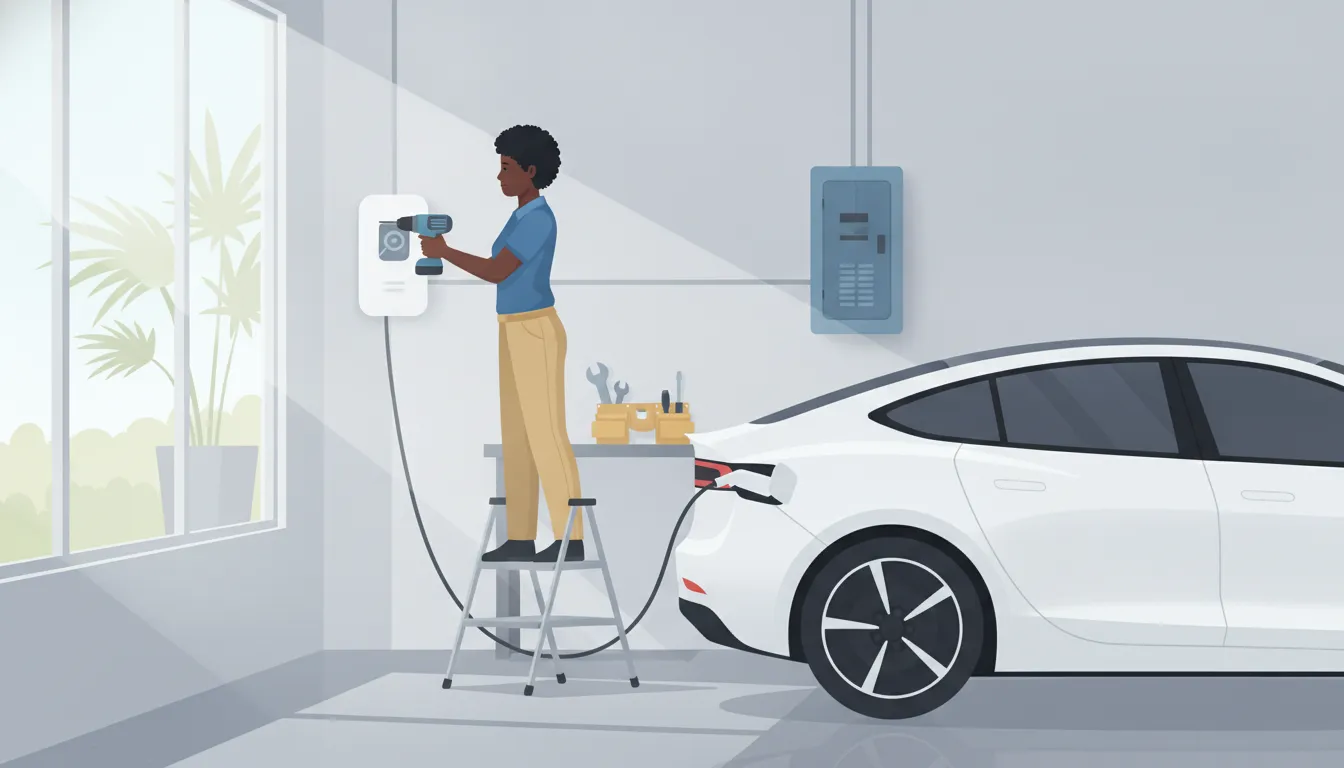
Choosing an EV charger is less about finding the most powerful model and more about finding the right fit for your car. Your electrical panel, and the way you drive. A short daily commute may be easy to support with slower overnight charging, while a larger battery or irregular driving schedule can make faster home charging worthwhile.
The best EV chargers for home match your vehicle's charging capability and your daily mileage while working safely with your home's available electrical capacity. Level 1 charging can add about 3 to 5 miles of range per hour. While Level 2 can add about 25 to 40 miles per hour but typically requires a dedicated 240-volt circuit.
That choice also depends on whether you want a simple plug-in setup or a permanent hardwired installation, plus features such as scheduling and outdoor-rated protection. In Florida, the mounting location and exposure to rain and heat matter too, whether your charger lives in a garage, carport, or along an exterior wall. Start by comparing the charging options with your actual routine, then consider what your home's electrical system can support. The good news is that you do not need to become an electrical engineer to make the right decision. A licensed electrician can walk you through the practical trade-offs. Confirm your panel has room for a new dedicated circuit and flag the permits or load questions that affect a safe, code-compliant install. With that context in hand, you can shop with confidence instead of guessing at specs.
Schedule Service for a quick home EV charger evaluation.
Which Home EV Charger Is Best for Your Setup?
The best EV charger for home use is the one that matches your daily driving, your vehicle's charging needs, and what your electrical system can safely support. Most EV drivers charge overnight at home with Level 1 or Level 2 equipment. So the right choice is usually less about buying the most powerful unit and more about restoring enough range before your next trip. The U.S. Department of Energy recommends weighing your driving habits, home, and budget when choosing a charging level.
Start with your daily driving routine
Estimate how far you typically drive between overnight charging sessions. Level 1 equipment adds approximately 3 to 5 miles of range per hour. That can be a practical fit for a shorter commute, a plug-in hybrid, or a household that has plenty of time to recharge between trips. The EPA identifies Level 1 as best suited to short commutes and PHEVs. If your daily mileage is modest and your vehicle is parked overnight, you may not need a faster setup.
Level 2 is the more practical choice when you drive longer distances, have a larger battery, or need a more predictable recharge on a tight schedule. A Level 2 charger can add approximately 25 to 40 miles of range per hour. But it generally operates at 240 volts and requires a dedicated circuit similar to the circuit used for a dryer or oven. That additional speed can make a meaningful difference for drivers who need to start each morning with a fuller battery.
Check the home before choosing the equipment
A charger that looks ideal on paper may not be the right fit for your panel, available circuits, or parking location. Some homes have enough electrical capacity for Level 2 charging without a panel upgrade, while others may need additional electrical work. A certified electrician should evaluate the home's capacity before equipment is selected or installed. EV charging is treated as a continuous load under the National Electrical Code, so capacity and circuit protection matter for safe, reliable operation.
Your installation location also affects the decision. Garage charging may allow more flexibility, while an outdoor unit must be specifically rated for outdoor use. Outdoor charging can be safe in rainy conditions when the equipment is properly rated. For high-amperage, permanent, or some outdoor installations, a hardwired connection may be preferred or required by the manufacturer.
Balance features with your budget
You do not need to pay for features you will not use. Basic equipment may be enough when your main goal is overnight charging. Smart Level 2 models can add scheduling, charging timers, energy data, and other connected controls. Which may be useful if you want more visibility over when and how the vehicle charges. State or utility incentives may also help offset equipment costs, but availability can change.
Before you buy, confirm that the charger is compatible with your vehicle and choose safety-certified equipment, such as an ENERGY STAR rated product. Then arrange professional EV charger installation so the charger and home's electrical capacity are evaluated together.
Level 1 vs Level 2 Chargers: Which Do You Really Need?
The right charging level depends less on a product's feature list and more on how you use your vehicle each day. Most EV and plug-in hybrid drivers charge at home overnight, while the vehicle is already parked. For some Florida homeowners, a standard Level 1 setup provides enough range by morning. Others need the faster recovery of Level 2, especially when they drive longer distances or need to replenish a larger battery within one night.
When Level 1 charging may be enough
Level 1 equipment uses a standard household outlet and adds approximately 3 to 5 miles of range per hour. That slower pace can work well for a short daily commute, limited driving, or a plug-in hybrid vehicle with a smaller battery. If your car is parked at home for many hours, it may replace the range you used during the day without requiring a new charging circuit.
The U.S. Department of Energy notes that many EV owners can meet their daily range needs with overnight Level 1 charging when a suitable outlet on a dedicated branch circuit is available near the parking space. That does not mean every existing outlet is automatically appropriate. A qualified electrician can help confirm that the circuit and outlet are suitable for continuous charging.
When Level 2 is the better fit
Level 2 charging operates at 240 volts and can add approximately 25 to 40 miles of range per hour. It typically requires a dedicated circuit similar to the circuit used for a clothes dryer or oven. This faster option is often the practical choice for drivers with longer commutes, less predictable schedules. Or an EV with a large battery that needs to reach a full charge during a single overnight period.
Level 2 does not automatically mean you need a panel upgrade. Some homes already have enough electrical capacity, while others may need additional circuit work. A licensed electrician should evaluate the panel before you choose equipment so the charger matches the home's capacity and the vehicle's requirements.
| Factor | Level 1 Charger | Level 2 Charger |
|---|---|---|
| Power source | Standard household outlet | 240-volt dedicated circuit |
| Range added per hour | About 3 to 5 miles | About 25 to 40 miles |
| Best for | Short commutes, lighter driving, and many PHEVs | Larger batteries, longer trips, dependable overnight charging |
| Typical install need | Usually a suitable outlet on a dedicated circuit | New circuit and electrical capacity review, often plus a permit |
There is no universal answer to which option is among the best EV chargers for home. The best fit is the one that meets your driving schedule without exceeding your home's electrical capacity. If Level 2 sounds right for your routine, professional EV charger installation can confirm the circuit, location, and equipment requirements before work begins.
Best Home EV Chargers for 2026: What to Look For
Once you know how much charging your household needs, compare the charger itself by how it will fit your routine, parking location, and electrical setup. The best EV chargers for home are not necessarily the most feature-heavy models. They are the ones that provide dependable charging without creating an awkward connection. Exposing equipment to the weather, or asking more of your electrical system than it can safely support.
Plug-in or hardwired?
A plug-in charger can be a practical choice when you want the option to disconnect or replace the equipment later. It also requires a properly installed receptacle that matches the charger's requirements. A hardwired charger connects directly to the electrical system and can provide a cleaner, more permanent setup. Hardwired connections are sometimes preferred for high-amperage charging, outdoor installations, or equipment intended to stay in place long term. The U.S. Department of Energy's Alternative Fuels Data Center notes that some manufacturers require hardwiring for outdoor use and recommend it for high-amperage charging. Review the federal home-charging guidance before treating a plug or hardwire connection as interchangeable.
Think about where the charger will live as well as which connection you prefer. In a Florida garage, a plug-in unit may be convenient if the receptacle is correctly located and protected. For a driveway or carport, a permanent hardwired installation may better suit the exposure and everyday wear. Your electrician can help match the equipment connection to the location instead of choosing based only on the product box.
Which smart features are useful?
Smart charging features can be worthwhile when your schedule changes or you want more control over when the vehicle draws power. Look for features such as charging timers, scheduling, usage data, status notifications, and load-management capability. Scheduling may help you charge during off-peak electricity hours when your utility offers time-based rates. Data and status information can also make it easier to notice interruptions before a low battery becomes a morning problem.
Do not pay for connectivity simply because it sounds advanced. A reliable charger with controls you will actually use is more valuable than an app that adds complexity. Confirm that the charger works with your vehicle and that the controls remain practical if your home Wi-Fi is unavailable.
Is it rated for outdoor use?
For a charger installed outside, choose equipment specifically rated for outdoor use. Properly rated residential charging equipment can be used outdoors, including while the vehicle is charging in the rain, according to the AFDC. That does not mean every charger is suitable for an exposed Florida installation. Check the product's outdoor rating, follow the manufacturer's mounting requirements, and account for rain, heat, humidity, and direct sun. A garage-mounted unit still needs a sensible cable route and protection from accidental impact.
Does it meet recognized safety standards?
Safety certification should be a non-negotiable buying criterion. The AFDC recommends safety-certified equipment, including products carrying the ENERGY STAR label, together with a certified electrical contractor. Look for clear certification information from the manufacturer rather than relying on vague marketplace descriptions. Status lights and basic safety features are standard on most modern Level 2 products, but the equipment still has to be compatible with your vehicle and home.
Before purchasing, share the exact model and connection requirements with a certified electrician. The right product decision includes the charger, its location, and a safe electrical match.
What Home EV Charger Installation Really Involves
Choosing among the best EV chargers for home use is only part of the decision. The charger also has to fit your vehicle, your parking location, and the electrical system already serving your house. A professional installation starts with those practical details, not with mounting a unit on the wall.
Checking your panel and available capacity
First, the electrician evaluates your electrical panel and the home's available capacity. This matters because a Level 2 charger uses 240 volts and can add roughly 25 to 40 miles of range per hour. Some homes have enough capacity for the new load, while others may need an added circuit or an electrical capacity upgrade. A qualified electrician can confirm which situation applies before equipment is installed. The U.S. Department of Energy's Alternative Fuels Data Center recommends verifying adequate electrical capacity before adding Level 2 equipment: see its home charging guidance.
The electrician also considers the distance from the panel to the parking space and where the charger will be mounted. A garage installation may be straightforward, while an outdoor location requires equipment rated for outdoor use and careful routing of the wiring. Outdoor EV charging can be safe in the rain when the equipment and installation are designed for that environment.
Adding the right dedicated circuit
A Level 2 charger generally needs its own 240-volt circuit, similar to the dedicated electrical service used by a dryer or oven. Your electrician sizes that circuit for the charger's requirements and the home's available capacity. EV charging is treated as a continuous load under the National Electrical Code, so the circuit cannot be planned like an occasional-use receptacle. Applying the appropriate NEC requirements helps reduce overheating risks and supports reliable charging.
Choosing plug-in or hardwired installation
Some chargers connect through a suitable receptacle, while others are hardwired directly into the electrical system. The choice depends on the equipment, the amperage, the location, and how permanent you want the setup to be. Hardwiring is often preferred for high-amperage, outdoor, or permanent installations, and some manufacturers require it outdoors. Your electrician can explain the tradeoffs instead of assuming one connection works for every home.
In practice, a typical professional home EV charger installation follows a process you can follow from the homeowner's side:
- Ask for an evaluation of your electrical panel and available capacity before buying equipment.
- Confirm the charger type, amperage, and whether a plug-in or hardwired connection fits your parking location.
- Review the panel for a suitable dedicated circuit and consider any electrical capacity work needed.
- Plan the charger mount, wiring route, and whether the installation requires a permit.
- Let the technician complete the circuit and charger work, then verify everything operates correctly and safely.
Local and state requirements may also mean that a permit is needed. A licensed professional can coordinate the installation around applicable codes and permitting requirements, then verify that the finished circuit and charger are operating as intended. For guidance tailored to your panel and parking setup, consider professional EV charger installation before purchasing equipment.
How Much Does a Home EV Charger Setup Cost?
There is no responsible one-size-fits-all price for a home EV charger setup. The total depends on more than the charger you choose. You may purchase the charging unit separately, then account for electrical labor. The distance from your panel to the parking area, the type of connection, and any permit requirements. A quick evaluation of your home is the best way to receive an accurate quote.
What goes into the total?
The equipment itself is one part of the decision. The best EV chargers for home use should match your vehicle, driving routine, available electrical capacity, and preferred installation location. A basic setup may involve connecting equipment near an existing, suitable circuit. A Level 2 charger commonly requires a 240-volt dedicated circuit, similar to the circuit used for a dryer or oven. That can mean new wiring and labor, even when the charger has already been purchased. EPA guidance also emphasizes that the appropriate charging level depends on your driving habits, home, and budget.
Some homes have enough capacity for the planned charger without a panel upgrade. Others may need additional electrical work, such as a new dedicated circuit, load-management solution, or panel upgrade. A certified electrician must confirm what your electrical system can safely support before installation. EV charging is treated as a continuous load under the National Electrical Code, so the circuit and equipment need to be sized and installed accordingly. Local authorities may also require permits. Requirements and labor needs vary by home, which is why a quick evaluation matters more than an online cost range.
Can incentives reduce the equipment cost?
State and utility incentives may be available to help offset the cost of home charging equipment. Eligibility, application rules, and available programs can change, so check current guidance and ask your electrician what may apply to your project. An incentive may reduce equipment expense, but it does not eliminate the need for a safe, code-compliant installation.
Schedule Service for a quick home EV charger evaluation and an honest quote for your setup.
What Makes a Home EV Charger Best for a Florida Home?
Florida homeowners have to think about more than charging speed. The best fit also needs to work with where you park, how exposed the equipment will be, and how your home's electrical system is configured. A charger mounted in a Port St. Lucie garage may have different requirements from one installed on an exterior wall near a driveway.
Outdoor installation can be safe, including during rain, when the equipment is specifically rated for outdoor use. The U.S. Department of Energy's Alternative Fuels Data Center recommends outdoor-rated equipment for exterior installations: review its home charging guidance before choosing a unit. In Florida, look closely at the manufacturer's outdoor rating and installation instructions, especially if the charger will receive direct sun, heavy rain, or wind-driven moisture. A garage location may offer more protection, but it still needs to be convenient for the vehicle and reachable without creating a trip or cord hazard.
When hardwiring makes sense
A plug-in charger can offer flexibility, but a hardwired connection is often the better choice for a permanent installation, higher-amperage charging, or equipment mounted outdoors. The same federal guidance notes that hardwiring is recommended for high-amperage charging and may be required by some manufacturers for outdoor installations. Your electrician can match the connection method to the charger, the planned location, and the available panel capacity rather than treating every home the same.
Look for clear safety feedback
Modern Level 2 equipment commonly includes standard safety features and status lights, making it easier to tell whether the unit is powered, charging, or reporting a problem. Smart features such as timers, data collection, scheduling, and communications may also be useful if you want more control over when the vehicle charges. These features should support your routine, not distract from the essentials: certified equipment, correct installation, and a location that protects the charger while keeping it accessible.
For homeowners in Port St. Lucie and across the Treasure Coast, a local electrical professional can evaluate the proposed location and connection before the equipment is purchased. If an electrical issue develops after installation, My Electrician FL also provides 24/7 emergency support. For a safer product match and installation plan, visit professional EV charger installation or explore our full electrical services. You can also reach out any time through our contact page.
Frequently Asked Questions
Do I need a Level 2 charger?
Not always. Level 1 may cover a short daily commute or a plug-in hybrid when the vehicle can charge overnight, adding about 3 to 5 miles of range per hour. Level 2 is usually the more practical choice for longer commutes, larger batteries, or drivers who want more range during an overnight parking period. The EPA explains the differences between home charging levels.
Can I install an EV charger myself?
A simple Level 1 setup may use an existing outlet, but a Level 2 installation commonly involves a 240-volt circuit, electrical capacity review, and possibly a permit. A licensed electrician can verify that the equipment, circuit, and installation meet applicable local and state requirements. The U.S. Department of Energy recommends professional guidance for home charging installations.
Will I need a panel upgrade for home charging?
Not necessarily. Some homes have enough capacity for a new Level 2 circuit, while others may need an added circuit or electrical capacity upgrade. An electrician should evaluate the main panel and existing loads before you purchase equipment, rather than assuming every home needs or does not need an upgrade.
Is it safe to install an EV charger outdoors?
Yes, provided the charger is rated for outdoor use and installed correctly. Outdoor-rated equipment can be used in the rain, but the location, wiring method, and mounting details still matter. For a permanent or high-amperage installation, a hardwired connection may be preferred or required by the equipment manufacturer. See the DOE guidance on outdoor home charging.
Ready to Schedule Your EV Charger Installation?
The best home EV charger is one that fits your vehicle, driving routine, and home's electrical capacity. A professional evaluation can help you choose a practical setup and identify the right circuit, mounting, and equipment requirements before installation. Schedule Service for professional EV charger installation with My Electrician FL today, or call 877-762-7483 to discuss your options with the team.
My Electrician FL serves homeowners across the Treasure Coast, from Palm Beach Gardens through Vero Beach. We provide upfront, flat-rate pricing, a two-year warranty on parts and labor, and 24/7 emergency electrical support when you need it. Getting started is simple: reach out for a quick evaluation. And we will help you choose the right charger and confirm your home is ready for a safe installation.